
CO₂ Lewis Structure
The CO₂ Lewis structure is O=C=O, with carbon in the center and a double bond to each oxygen. CO₂ has 16 valence electrons: each oxygen has two lone pairs, and carbon has none. The O–C–O bond angle is 180°, giving CO₂ a linear shape. The molecule is nonpolar because its two C=O bond dipoles cancel.
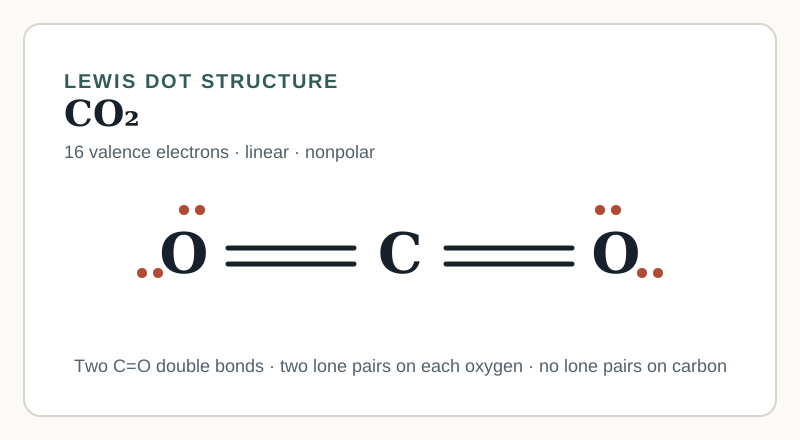
| Valence e⁻ | 16 |
|---|---|
| C=O double bonds | 2 |
| Lone pairs | 4 total (2 per O) |
| Geometry | Linear |
| Bond angle | 180° |
| Polarity | Nonpolar |
How to Draw the CO₂ Lewis Structure
Start with 16 valence electrons and an O—C—O skeleton. Complete the oxygen octets, then use one lone pair from each oxygen to form a second C—O bond. The resulting O=C=O structure gives carbon and both oxygen atoms complete octets.
Step 1Count the valence electrons
Carbon contributes 4 valence electrons and each oxygen contributes 6. CO₂ is neutral, so the total is 4 + (2 × 6) = 16 electrons. All 16 appear in the finished drawing.
Atom Count Valence e⁻ Total C 1 4 4 O 2 6 12 Total 16 Step 2Choose carbon as the central atom
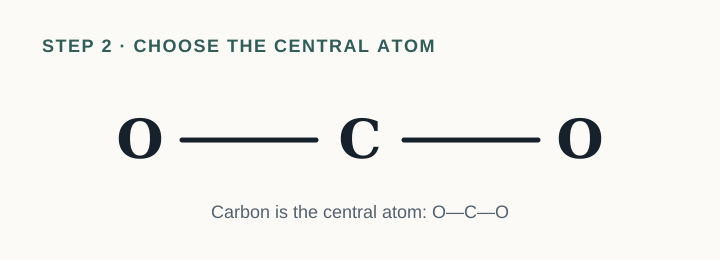
Oxygen is more electronegative than carbon, so carbon belongs in the middle. Begin with the single-bond skeleton O—C—O. The two single bonds use 4 electrons, leaving 12.
Step 3Complete the oxygen octets
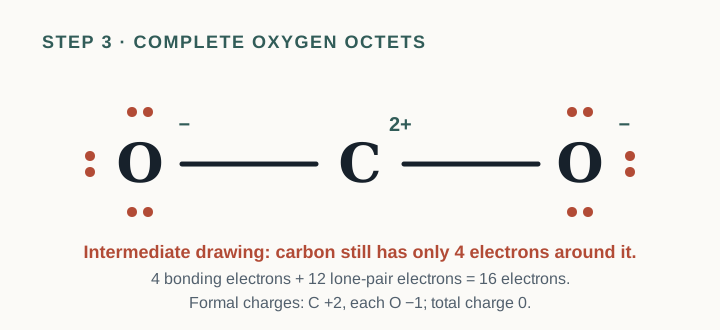
Place three lone pairs on each oxygen. This uses the remaining 12 electrons, so all 16 valence electrons have been assigned. Each oxygen has an octet, but carbon has only four electrons from its two single bonds.
Step 4Form two C=O double bonds
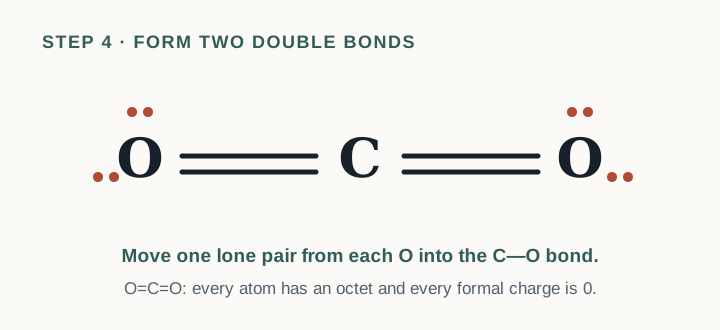
Move one lone pair from each oxygen into its C—O bond. Each move creates a second bonding pair. The finished structure is O=C=O: carbon has eight electrons, and each oxygen still has eight.
Step 5Verify the electron count and formal charges
The final drawing has two double bonds (8 bonding electrons) and four lone pairs on oxygen (8 nonbonding electrons), for 16 electrons total. Carbon and both oxygens have octets, and every formal charge is 0.
- All 16 valence electrons are accounted for
- Carbon has a full octet from two C=O double bonds
- Each oxygen has a full octet and two lone pairs
- Formal charges are 0 on every atom
CO₂ Valence Electrons
Carbon contributes 4 valence electrons. The 2 oxygen atoms contribute 2 × 6 = 12 valence electrons. Together, CO₂ has 16 valence electrons to place. Of those, 8 fill the bonds and 8 sit as lone pairs (2 on each oxygen).
| carbon: 4 valence electrons |
| 2 × oxygen: 2 × 6 = 12 |
| Total: 4 + 12 = 16 |
CO₂ Lewis Structure with Formal Charges
Formula
Formal charge = valence e⁻ − nonbonding e⁻ − ½ × bonding e⁻
| Atom | Calculation | Formal charge |
|---|---|---|
| C | 4 − 0 − ½(8) = 0 | 0 |
| O | 6 − 4 − ½(4) = 0 | 0 |
| O | 6 − 4 − ½(4) = 0 | 0 |
The formal charges sum to 0, matching the neutral molecule. That makes this the preferred CO₂ Lewis structure: zero formal charge on every atom.
CO₂ Molecular Geometry
| Electron geometry | Linear |
|---|---|
| Molecular geometry / shape | Linear |
| VSEPR notation | AX₂ |
| Bond angle | 180° |
On the central carbon, count electron domains the VSEPR way: each bonded neighbor is one domain (a double or triple bond still counts as one), and each lone pair is one more. CO₂ has 2 bonding domains and no lone pairs (AX₂), for 2 electron domains in total.
Two domains repel to opposite sides of the carbon, so O═C═O is linear with a bond angle of 180°. With no lone pairs on the central atom, the electron geometry and the molecular geometry are the same: both linear.
Compare CO₂ with H₂O: both have a central atom bonded to two outer atoms, but H₂O has two lone pairs on its central oxygen (AX₂E₂). Those lone pairs make water bent, with an H–O–H bond angle of about 104.5°. Carbon in CO₂ has no lone pairs, so CO₂ remains linear with a 180° bond angle.
Is CO₂ Polar or Nonpolar?
CO₂ is nonpolar.
CO₂ is nonpolar even though each C=O bond is polar. Oxygen is more electronegative than carbon (3.44 versus 2.55), so each bond dipole points toward oxygen. In linear O=C=O, the two equal dipoles point in opposite directions and cancel, giving CO₂ zero net dipole moment. In bent SO₂, the bond dipoles cannot cancel completely, so SO₂ is polar.
Two equal C=O bond dipoles point in opposite directions and cancel — net dipole 0.
| CO₂ | Linear · Nonpolar — dipoles cancel |
|---|---|
| SO₂ | Bent · Polar — dipoles do not cancel |
CO₂ Hybridization
Carbon in CO₂ is sp-hybridized.
Carbon in CO₂ is sp-hybridized. In the standard valence-bond model, its two sp orbitals form the two C–O σ bonds, while two unhybridized p orbitals form the π bonds. Each C=O double bond contains one σ bond and one π bond. The two bonding regions point 180° apart, consistent with CO₂'s linear molecular geometry.
CO₂ Lewis Structure Summary
| Chemical name | Carbon dioxide |
|---|---|
| Total valence electrons | 16 |
| Central atom | Carbon |
| Structure | O═C═O |
| Bond type | Two C=O double bonds |
| Lone pairs on carbon | 0 |
| Lone pairs on outer atoms | 2 on each oxygen |
| Electron geometry | Linear |
| Molecular geometry | Linear |
| VSEPR | AX₂ |
| Bond angle | 180° |
| Hybridization | sp |
| Polarity | Nonpolar |
| Formal charge | 0 on every atom |
| Resonance | O=C=O is the dominant contributor |
| Overall charge | 0 |
Try Another Lewis Structure
Enter another formula to draw its Lewis structure — bonds, lone pairs, formal charges, and the steps behind them.
Need the mass instead? See the CO₂ Molar Mass →
Related Lewis Structures
Compare these Lewis structures to see how valence electrons, bonding, and molecular shapes differ.
Frequently Asked Questions
What is the Lewis structure of CO₂?
The Lewis structure of CO₂ is a central carbon atom double-bonded to two oxygen atoms, written O=C=O. Carbon has no lone pairs, each oxygen keeps two lone pairs, and all 16 valence electrons are used. Every atom carries a formal charge of 0.
How many valence electrons does CO₂ have?
CO₂ has 16 valence electrons: 4 from carbon and 6 from each of the two oxygens (2 × 6 = 12). Eight of them fill the two C=O double bonds, and the other eight sit as lone pairs on the oxygens.
What is the molecular geometry of CO₂?
CO₂ has a linear molecular geometry. Carbon is the central atom with two bonding domains and no lone pairs, so the two C=O bonds point in opposite directions, 180° apart.
Is CO₂ polar or nonpolar?
CO₂ is nonpolar. Each C=O bond is polar, but the molecule is linear and symmetric, so the two equal bond dipoles point in opposite directions and cancel exactly, giving a net dipole of zero.
What is the bond angle of CO₂?
The bond angle in CO₂ is exactly 180°. With two electron domains and no lone pairs on carbon, the O=C=O bonds sit directly opposite each other.
What is the hybridization of carbon in CO₂?
Carbon in CO₂ is sp-hybridized. Its two electron domains combine one s orbital and one p orbital into two sp hybrids pointing 180° apart, while the two remaining p orbitals form the π bonds of the double bonds.